
Understanding Aviation Safety Patterns Across Africa, 2016 to August 2026
Africa’s aviation sector is entering an important period of growth. Passenger demand, route connectivity and fleet investment are expanding, while African airlines and airports continue to strengthen their position within regional and international markets. AFRAA projects continued growth in passenger traffic and a significant expansion of Africa’s commercial aircraft fleet over
the coming decades.
This growth makes aviation safety increasingly important not only from an operational and regulatory perspective, but also from a commercial intelligence perspective. Safety performance can influence passenger confidence, airline network decisions, airport operations, insurance exposure, infrastructure investment, aircraft utilisation, maintenance requirements and the deployment of aviation technology.
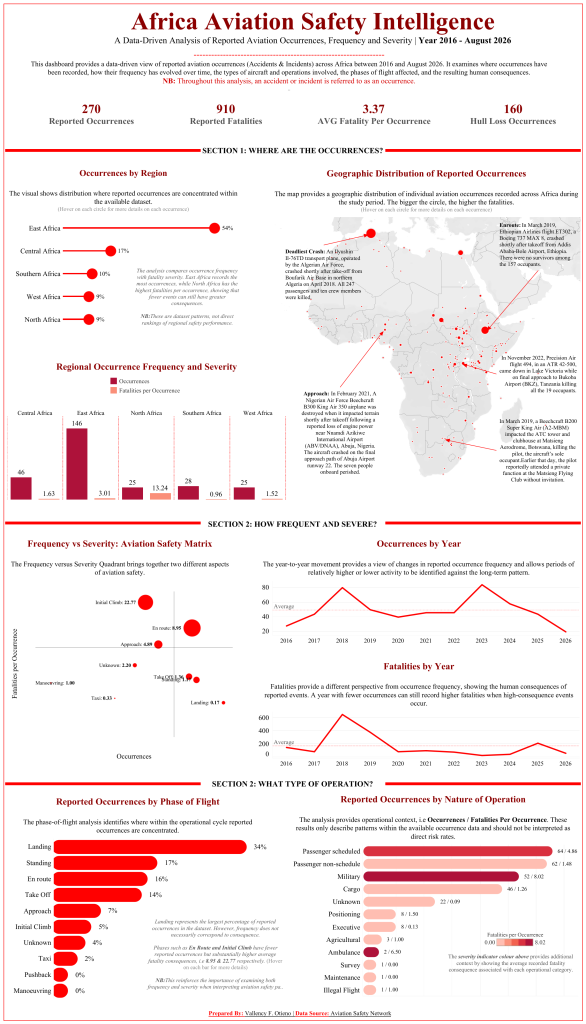
This dashboard analyses 270 reported aviation occurrences and 910 recorded fatalities across Africa between January 2016 and August 2026. Rather than looking at occurrences simply as individual accidents and incidents, the analysis examines their geographic distribution, frequency, severity, timing, phase of flight and nature of operation to identify broader patterns
within the available data.
As we delve into the insights, here is the interactive link to the analysis of Africa Aviation Safety Intelligence.
The period captures several significant developments in African aviation safety. The 2019 Ethiopian Airlines Flight 302 accident, for example, demonstrated how a single high-consequence event can extend far beyond the immediate loss of life, affecting aircraft fleets, airline operations, regulatory oversight, passenger confidence and the global aviation supply chain.
The 2022 Precision Air PW494 accident in Tanzania similarly illustrates the operational consequences that can arise during critical phases of flight and the importance of understanding safety beyond headline accident numbers.
- The geographical analysis shows where reported occurrences are concentrated across the continent and how frequency differs from fatality consequence. East Africa records the largest number of occurrences in this dataset, while North Africa records a substantially higher average fatality consequence per occurrence. This demonstrates that the number of events alone does not provide a complete picture of safety patterns.
- The Frequency versus Severity analysis therefore forms a central part of the dashboard. By combining occurrence frequency with fatalities per occurrence, it distinguishes between areas where events occur more frequently and areas where individual events have greater recorded consequences.
- The time-series analysis examines how reported occurrences and fatalities have changed during the study period. Comparing the two trends highlights an important principle: frequency and consequence do not necessarily move together. A period with relatively few occurrences can still produce significant human consequences when high-fatality events occur.
- The Phase of Flight analysis adds an operational perspective by examining where within the flight cycle occurrences are concentrated. Landing represents the largest number of reported occurrences in the dataset, while phases such as En Route and Initial Climb show considerably higher average fatality consequences. This distinction is relevant to areas such as runway safety, flight operations, crew training, aircraft performance, airport infrastructure and safety management.
- The Nature of Operation analysis provides further commercial and operational context by distinguishing between passenger, cargo, military and other types of aviation activity. Understanding these differences can help aviation stakeholders consider where particular safety challenges may intersect with network expansion, fleet deployment, airport infrastructure, ground handling, training, maintenance and other operational requirements.
Also Read: How Much Are Travellers Paying for Airport Passenger Tax in Africa?
From a commercial intelligence perspective, this is where aviation safety data becomes particularly valuable. A safety pattern can represent more than an operational concern. It can also indicate potential requirements for better safety analytics, predictive maintenance, runway and airport infrastructure improvements, crew and ground-handling training, safety management systems, occurrence reporting, aircraft health monitoring, risk assessment and other aviation technologies and services.
The broader industry context reinforces this importance. Africa’s safety performance has improved in several recent measures, but regional accident rates remain an area of attention. IATA reported that Africa’s accident rate improved from 12.13 accidents per million sectors in 2024 to 7.86 in 2025, although it remained the highest regional rate. AFRAA and industry partners have consequently continued to emphasise safety improvement, operational efficiency, data-driven oversight and stronger safety management across the continent.
The dashboard should therefore be viewed as an aviation safety intelligence tool rather than simply an accident statistics dashboard. Its purpose is to demonstrate how historical occurrence data can be transformed into insights about where events occur, how often they occur, how severe their consequences are, when patterns change, and which operational contexts require closer examination.
For airlines, airports, regulators, insurers, MRO organisations, aviation technology companies, training providers and other industry stakeholders, these patterns can provide a starting point for deeper analysis and targeted interventions.
Importantly, the analysis describes patterns within the reported dataset and should not be interpreted as a direct ranking of countries, regions, airlines or operations by safety performance. Occurrence counts are not exposure-adjusted and therefore do not represent direct probabilities or risk rates. More complete risk assessment would require additional denominators such as aircraft movements, departures, flight hours, fleet size and other relevant operational exposure data.
The central message is simple: as Africa’s aviation market grows, understanding safety through data becomes increasingly important. The opportunity is not only to understand what has happened, but to use data to identify where further investigation, innovation, investment and operational improvement may create value for African aviation.
About Vallency Otieno
With 8+ years of experience in aviation, Vallency excels at driving results and improving performance by implementing data-driven strategies. His passion lies in using analytical insights to impact commercial development and policy formation within the aviation industry. Find more of his work HERE